
Share on:

Why Natural Gas Demand Matters

Natural gas plays a central role in the U.S. energy system. It fuels power plants, heats homes and businesses, supports manufacturing, and increasingly connects domestic markets to global energy flows through liquefied natural gas (LNG) exports.

According to the U.S. Energy Information Administration (EIA), detailed data on production, consumption, storage, and exports is available through its Natural Gas Data portal. Tracking natural gas demand trends helps investors understand broader energy market fundamentals. Changes in consumption patterns may reflect economic conditions, infrastructure development, technological shifts, and evolving policy frameworks.


Power Generation Remains the Largest Driver
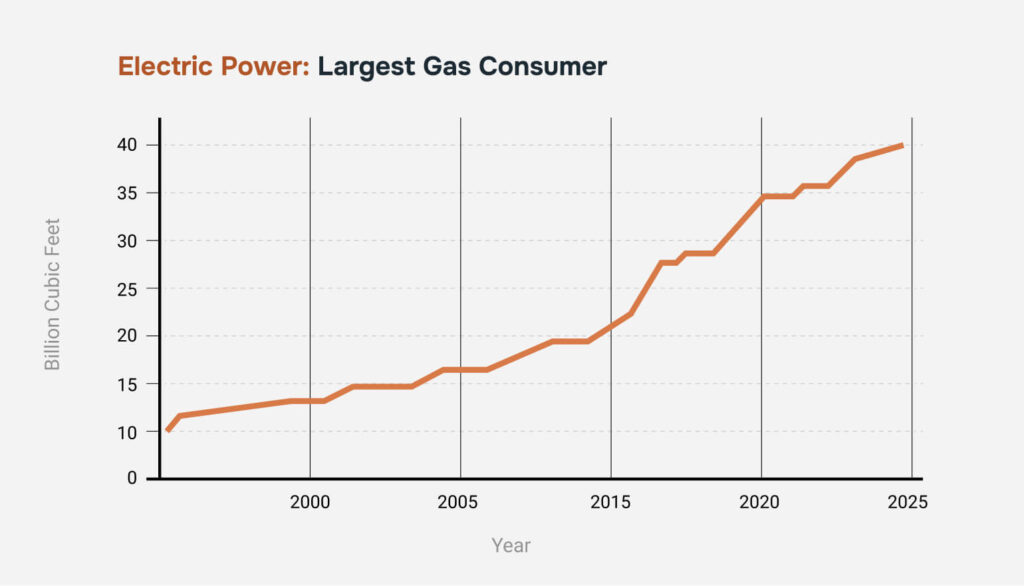
Line chart of U.S. natural gas consumption in the electric power sector over time.

The electric power sector remains the largest consumer of natural gas in the United States. EIA data on natural gas consumption by end use shows that gas-fired generation has expanded over the past decade during a period in which utilities retired coal capacity and increased reliance on flexible generation sources.

Natural gas plants are valued for their ability to ramp output up or down quickly. This flexibility supports grid reliability, especially as renewable generation from wind and solar grows. The EIA’s Electric Power Monthly provides ongoing insight into how fuel sources contribute to the U.S. generation mix.

For energy investors, this linkage between weather patterns, grid dynamics, and gas consumption illustrates the role natural gas currently plays in supporting grid operations.


LNG Exports and Global Linkages
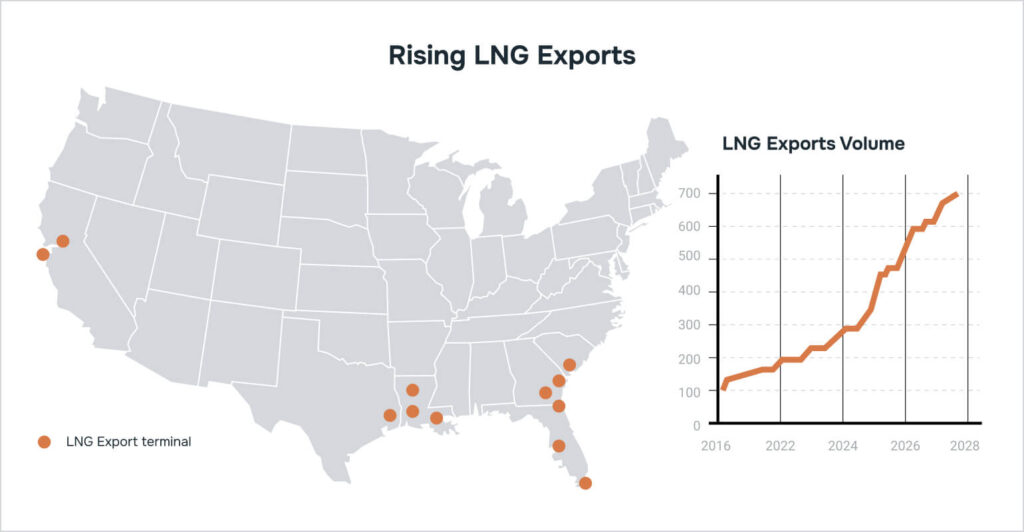
Map of U.S. LNG export terminals alongside chart showing export growth trend.

One of the most significant structural changes in U.S. natural gas demand has been the rise of LNG exports. The United States is among the world’s largest LNG suppliers, connecting domestic production to international markets in Europe, Asia, and Latin America.

The EIA tracks this growth through its U.S. LNG export data and regularly analyzes global developments in the Short-Term Energy Outlook. As export capacity has expanded, domestic demand has become more closely linked to global energy market conditions.

International price signals, geopolitical developments, and overseas storage levels can all affect U.S. gas flows. This global integration means natural gas is no longer solely a domestic supply-demand story. Instead, it sits at the intersection of global trade, infrastructure investment, and energy security.


Industrial and Seasonal Demand Patterns
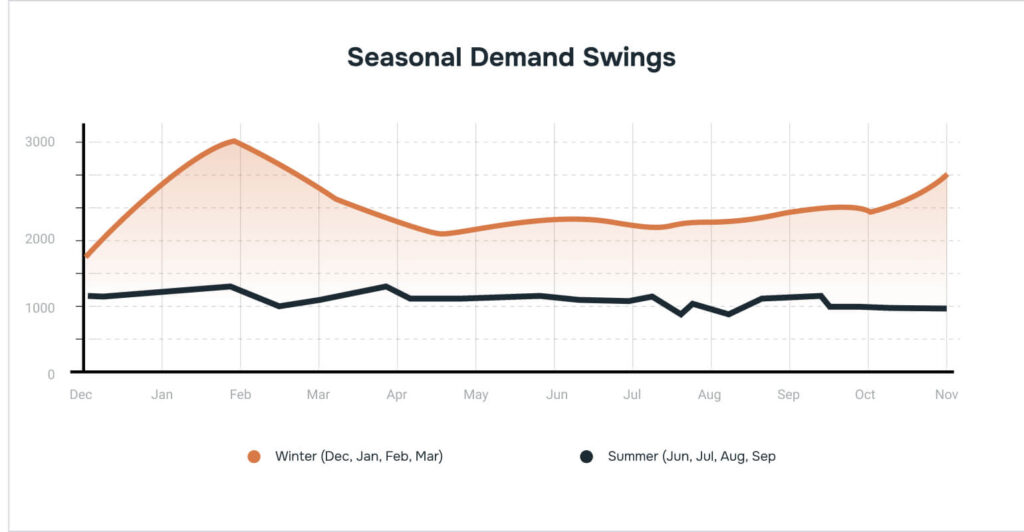
Chart comparing winter and summer natural gas consumption levels in the United States.

Beyond power generation and exports, the industrial sector represents a stable and significant source of demand. Natural gas is used as both a fuel and feedstock in industries such as chemicals, fertilizer, steel, and manufacturing. EIA’s industrial consumption data illustrates that this segment has historically provided a relatively steady baseline of demand.

Residential and commercial consumption, meanwhile, is highly seasonal. Winter heating demand can lead to sharp increases in usage, drawing down storage inventories and influencing short-term market dynamics. Weekly storage changes are reported in the EIA’s Natural Gas Storage Report.

These seasonal patterns underscore the importance of storage levels, pipeline infrastructure, and regional supply balances. They also demonstrate how demand is shaped by both structural factors and short-term variability.


What Demand Trends Signal for Long-Term Investors

Natural gas demand trends provide insight into broader energy system evolution:

  • Growth in LNG exports reflects infrastructure expansion and global integration.
  • Power sector demand highlights the fuel’s role in grid reliability.
  • Industrial usage may reflect levels of economic activity and domestic manufacturing output.
  • Seasonal swings reinforce the importance of storage and logistics.

For long-term investors, understanding these drivers provides context for evaluating natural gas within the broader energy system.

Demand data does not predict price movements. Instead, it helps clarify how infrastructure, policy, weather, and economic activity interact within energy markets.

As energy systems evolve, natural gas demand trends remain one lens through which broader market developments can be evaluated.


What This Means for Long-Term Energy Investors

For long-term investors, understanding global energy markets is essential—even when evaluating domestic-focused operators.

Key considerations include:

  • Oil pricing is influenced by global supply-demand balances.
  • LNG exports connect U.S. natural gas production to international markets.
  • Geopolitical events may influence supply flows and price signals.
  • Capital discipline moderates how quickly U.S. production responds.

U.S. production trends are not solely driven by domestic factors. It is part of a globally interconnected energy system shaped by international policy, trade flows, and long-term demand trends.


Resources

U.S. Energy Information Administration – Natural Gas Data
Comprehensive data on U.S. natural gas production, consumption, storage, and exports.
https://www.eia.gov/naturalgas/

EIA Short-Term Energy Outlook
Monthly projections covering supply, demand, and energy market developments.
https://www.eia.gov/outlooks/steo/


About Us

Eagle Natural Resources is a privately held oil and gas operating company based in Texas. We offer accredited investors direct access to U.S. energy projects focused on long-term value, transparency, and responsible development.

Contact

Eagle Natural Resources, LLC
RRC # 253075
5445 Legacy Dr. STE 440 Plano TX 75024
Phone: (833) 553-1534

There are significant risks associated with oil and gas investments. Information found on this site is for general purposes only and is not a solicitation to buy or an offer to sell securities. General information on this site is not intended to be used as individual investment or tax advice. Consult your personal tax advisor concerning the current tax laws and their applicability and effect on your personal tax situation.

Exclusive Opportunities Available Now

We’ve reserved a select number of cash-flowing energy investments for qualified investors. These offerings are available for a limited time and on a first-come basis.

Recipient – Registrant on www.EaglenNaturalResources.com

Disclosing Party – Lexstar Energy, DBA Eagle Natural Resources

Effective Date – Date of Registration

  1. Definitions.

(a) Disclosing Party and Recipient. The party disclosing Confidential Information is referred to as the “Disclosing Party,” and the party receiving Confidential Information is referred to as the “Recipient.”

(b) Confidential Information. “Confidential Information” means all information (whether in oral, written or electronic form) relating to the business, business relationship between disclosing party and recipient, personnel, marketing, customers, finances, products or services of the Disclosing Party, and includes confidential information received by the Disclosing Party from third parties.

  1. Permitted Use of Confidential Information.The Recipient must not use the Disclosing Party’s Confidential Information for any purpose without the explicit written approval of the Disclosing Party.
  2. Protect Confidential Information.The Recipient will keep the Disclosing Party’s Confidential Information confidential, and will also cause its directors, officers, employees and agents to keep the Disclosing Party’s Confidential Information confidential. The Recipient will take all necessary steps (including those steps that the Recipient takes to protect its own information that it regards as confidential) to maintain the confidentiality of the Disclosing Party’s Confidential Information.
  3. No Disclosure.The Recipient will not disclose the Confidential Information to any third party, nor the fact that it has obtained the Confidential Information, without the explicit written approval of the Disclosing Party.
  4. Legal Compulsion to Disclose Confidential Information.If the Recipient receives notice indicating that it may or will be legally required to disclose any of the Disclosing Party’s Confidential Information, it will notify the Disclosing Party promptly in writing so that the Disclosing Party may seek a protective order or other appropriate remedy, or waive compliance with this Agreement. If a protective order or other remedy is not obtained for whatever reason, or if the Disclosing Party waives compliance with this Agreement, the Recipient will disclose no more than that portion of the Confidential Information required to be disclosed.
  5. No Transfer.The Disclosing Party retains exclusive rights to its Confidential Information, and does not grant or transfer any right or license to the Recipient, except as set out in this Agreement.
  6. Return or Destruction.Within five business days of a request by the Disclosing Party:

(a) the Recipient will return to the Disclosing Party all materials in physical form (including any notes, summaries or memoranda relating to or derived from those materials by the Recipient) that contain the Disclosing Party’s Confidential Information or, at the Disclosing Party’s option, the Recipient may certify in writing that it has destroyed all such materials permanently and confidentially; and

(b) the Recipient will certify in writing that it has destroyed permanently all materials in electronic form (including emails and including any notes, summaries or memoranda relating to or derived from those materials by the Recipient) that contain the Disclosing Party’s Confidential Information.

  1. Disclosing Party Not Liable.The Recipient acknowledges that the Disclosing Party, its directors and its officers will have no liability to the Recipient resulting from the use of the Confidential Information by the Recipient.
  2. Non‑money Remedies.The Recipient acknowledges that money damages would not be a sufficient remedy for a breach of this Agreement, and that any court having jurisdiction may grant injunctive relief for an actual or threatened breach of any of the provisions of this Agreement, in addition to any other remedy available to the Disclosing Party.
  3. Integration.This Agreement constitutes the entire agreement between the parties relating to its subject matter. No amendment or waiver of this Agreement is binding unless agreed to in writing by the parties.
  4. Governing Law.This Agreement is governed by the laws in effect in the State of Texas.