Short-term thinking is the most expensive habit you can have as an energy investor.
Prices move. Headlines shift. Quarterly production numbers disappoint or surprise. And if you track all of it too closely, you’ll make the same mistake repeatedly – reacting to the moment instead of positioning your portfolio for what the next decade actually looks like.
The investors who consistently do well in energy aren’t the ones with the best market timing. They’re the ones who understood the long-term demand picture early, found quality assets within it, and held their conviction when the short-term noise got loud.
And their returns reflect it.
So what does the long term actually look like for your investment? The EIA’s Annual Energy Outlook 2026 – the most comprehensive government projection of U.S. energy through 2050 – gives us a clear picture. And for investors who know how to read it, the signal is hard to ignore.
The Demand Question Every Investor Asks First
The first thing you probably want to know is simple: will people still need oil and gas by the time my investment matures?
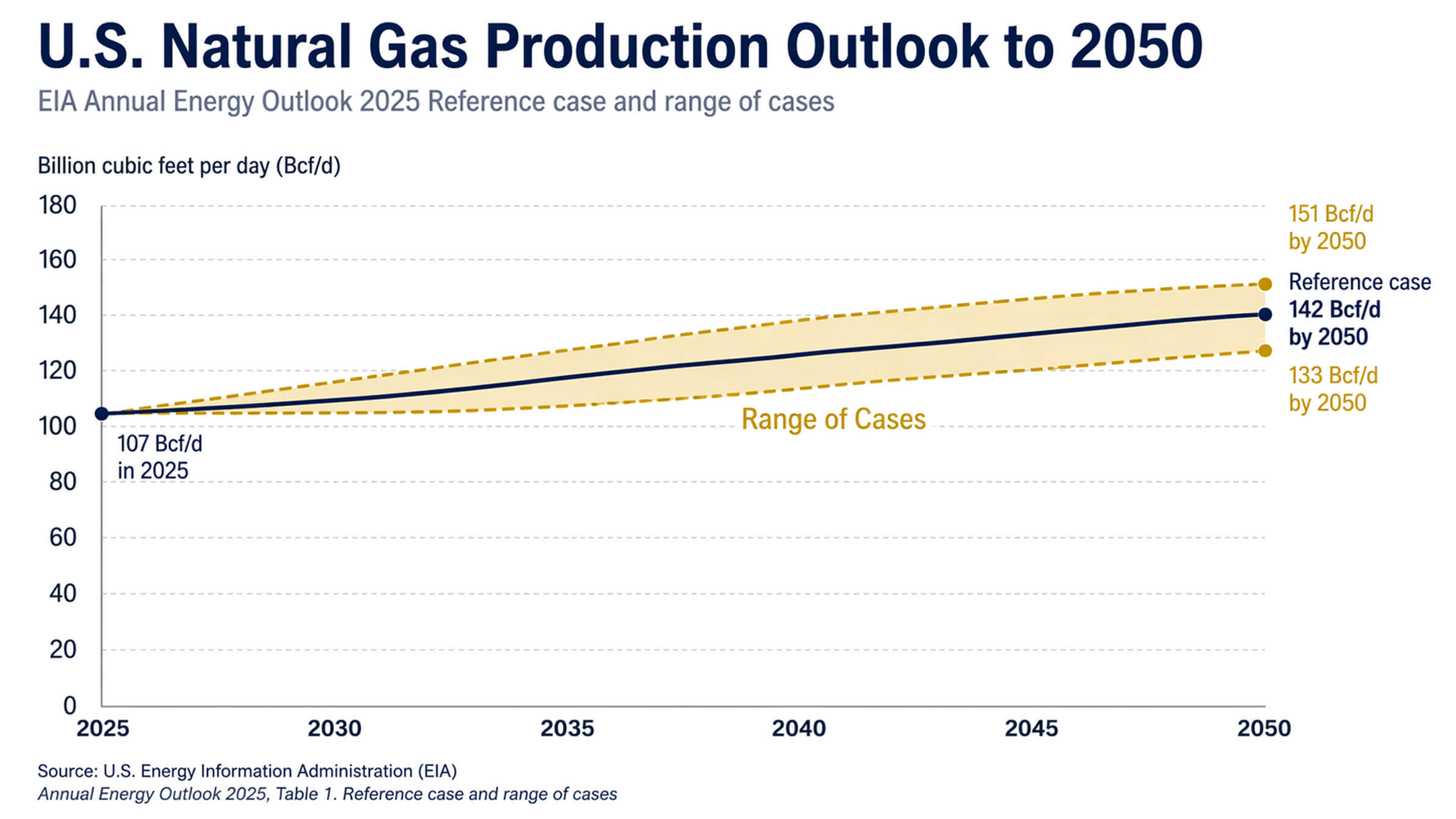
The answer, according to the AEO2026, is unambiguous. Natural gas production is projected to grow significantly, from 107 billion cubic feet per day in 2025 to between 133 Bcf/d and 151 Bcf/d by 2050 in most cases, driven by domestic and international demand.
That’s not a market in decline. That’s a market being asked to do significantly more – not less.
What this means for your capital: The fundamental question underlying any long-cycle energy investment is whether the commodity will still command value when your project is producing and your cash flows begin. Projections don’t guarantee outcomes – but when the government’s own modeling shows natural gas demand growing by up to 40% over the next 25 years across multiple scenarios, that’s a demand floor that protects your investment thesis.
You’re not betting on a market that’s fighting for survival. You’re investing in one that’s being asked to expand. And that expansion translates directly to sustained demand for what you’re producing.
Why Electricity Demand is Better News for Natural Gas Than Most Investors Realize
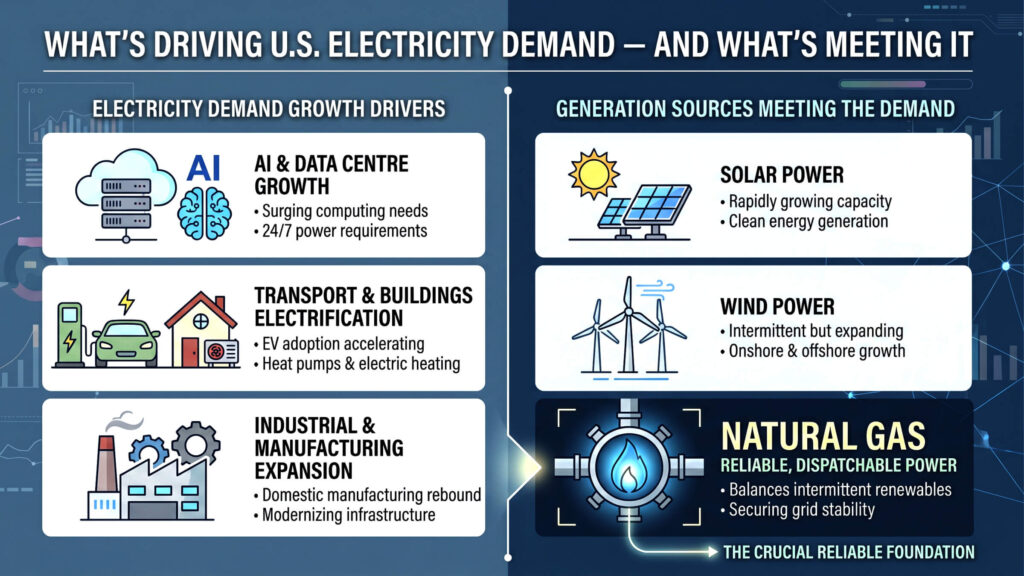
Here’s the dynamic that often gets lost in the energy transition narrative: the shift toward electrification doesn’t reduce the need for natural gas. In many scenarios, it increases it – which matters directly to your income.
Data center load is emerging as the dominant driver of long-term U.S. electricity growth. After a decade-plus plateau, national electricity demand has risen 2.1% annually over the past five years and is projected to grow at an average annual rate of 0.9%–1.6% per year through 2050.
And what powers that electricity growth? By 2050, natural gas, solar, and wind are projected to generate 80% of U.S. electricity combined – with natural gas playing the critical role of keeping the lights on when renewables go offline.
Which means, natural gas isn’t being displaced by the energy transition. It’s being recruited by it – as the reliable, dispatchable backbone that keeps the grid stable when renewables fluctuate.
What this means for your returns: Most investors look at renewables growth and assume it comes at the expense of natural gas. The data says otherwise. AI infrastructure, data centers, and electrification of industry are creating electricity demand that renewables alone can’t reliably meet. Natural gas & oil fill that gap – and investors get paid for it.
If you’re invested in U.S. oil & natural gas projects, you’re not positioned against the energy transition. In many respects, you’re positioned to benefit from the revenue it creates. That’s not speculation. That’s the structural demand pattern projected through 2050.
What Oil’s Long-Term Stability Actually Tells You About Risk
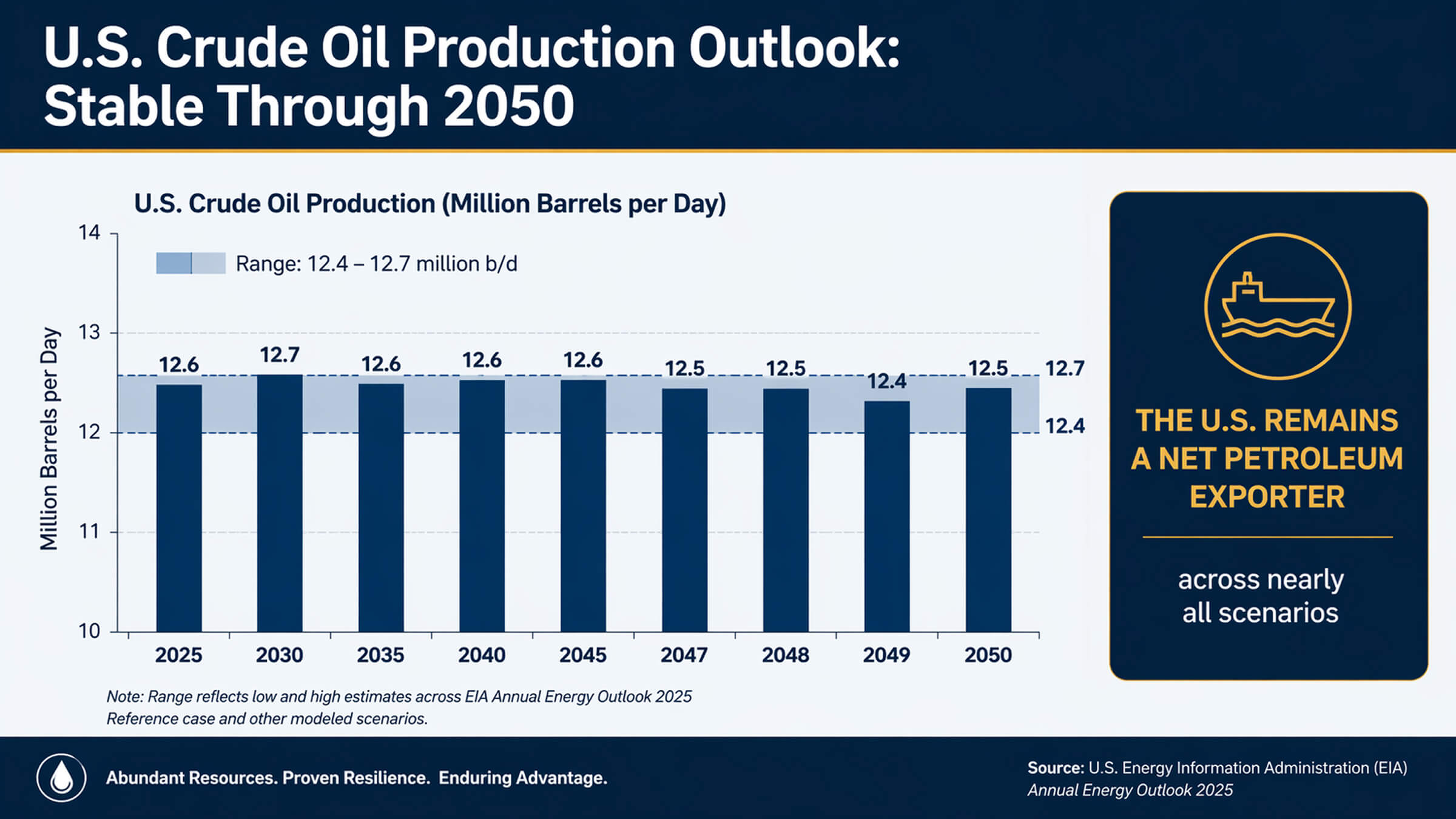
For oil-weighted investors, the AEO2026 paints a picture of structural stability rather than dramatic growth or collapse. U.S. crude oil production is projected to remain relatively stable, between 12.4 million barrels per day and 12.7 million b/d by 2050 in most cases, compared with 13.6 million b/d produced in 2025.
The United States is expected to remain a net exporter of petroleum in nearly all cases, with petroleum liquids exports in particular increasing.
What this means for your portfolio: Stability in a market of this size is not a consolation prize – it’s a foundation for your cash flow. It means U.S. oil production isn’t heading toward a cliff that could strand your investment. It means the market is maturing.
And in a maturing market, the projects that win are the ones with the best acreage, the lowest cost structures, and the most disciplined operators. The easy wins are narrowing – which means where you invest and who operates it matters more to your outcomes, not less.
If you’re in a quality project with strong fundamentals, this stability works in your favor. If you’re in a marginal acreage that only pencils at peak prices, this environment will expose that weakness.
The Slow Erosion Nobody Sees Coming
The AEO2026 also tells us – indirectly – what kinds of energy investments are most exposed over a 25-year horizon. And exposure means risk to your principal.
If 2024 power-sector emissions regulations are enforced, coal generation is projected to mostly disappear from the power sector. That’s what happens when a commodity loses its structural demand base – not quickly, but irreversibly.
What this means for protecting your investment: The investors who were overexposed to coal without a long-term demand thesis didn’t lose money in a single dramatic collapse. They lost it slowly, over years, while the structural case eroded beneath them.
The lesson for you as an oil and gas investor isn’t to avoid the sector – it’s to be rigorous about where within the sector your money is positioned. Marginal acreage that only works at high prices, or projects in basins with declining infrastructure, face a version of that same slow erosion.
Quality matters over time in ways that short-term returns can mask. And by the time you realize you’re in a structurally challenged asset, your capital is already committed.
How to Think About the Next 10 Years Instead of the Next 10 Weeks
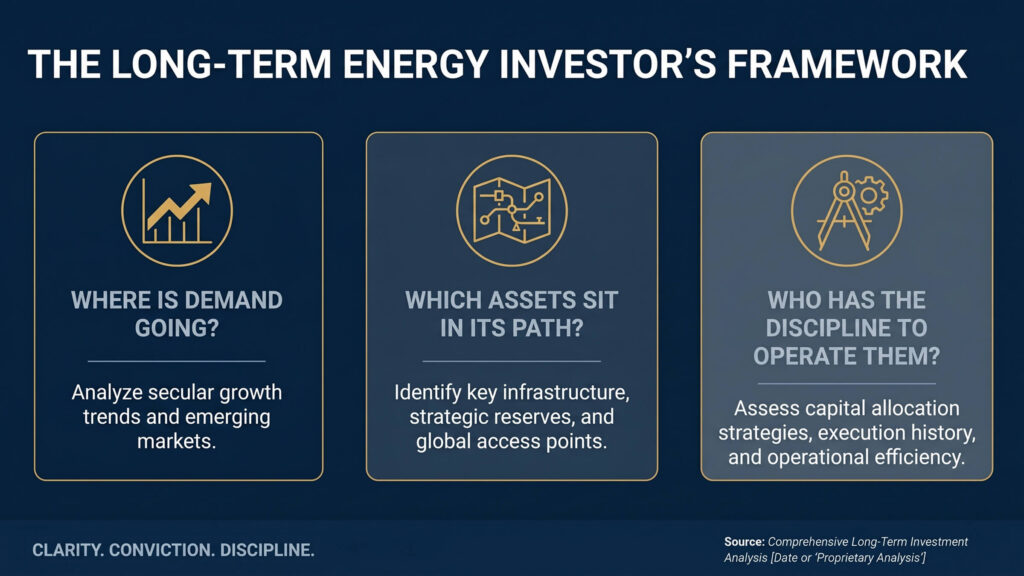
Long-term energy investing isn’t about predicting where prices will be in six months. It’s about understanding where demand will be in ten years, which assets sit in the path of that demand, and which operators have the discipline to extract value from those assets through multiple market cycles – and deliver it to you.
The AEO2026 gives you a credible, data-grounded answer to the first question. The second and third are where your due diligence comes in – and where the difference between your investment performing or underperforming is actually made.
When you approach energy investing this way – with a long-term demand thesis protecting your downside, quality asset selection positioning your upside, and operator discipline ensuring execution – you tend to make better decisions. Not because you’re smarter, but because you’re asking the questions that actually determine your outcomes.
At Eagle Natural Resources, we work with accredited investors who think in these terms – not reacting to the week, but positioning their portfolios for the decade. We build every project with your long-term returns in mind, not short-term optics.
If you’d like to understand how we evaluate long-term project economics – and how that evaluation is designed to protect your capital across market cycles – we’re happy to walk you through our approach.
For educational purposes only. Direct investments in oil and gas carry risk, including potential loss of principal.