
Panoramic image of a modern oil refinery facility with distillation towers and industrial processing equipment.

Share on:

Crude oil does not come out of the ground ready to use.

In its raw form, it is a mixture of hydrocarbons with different molecular structures, weights, and properties. Refineries exist to separate and transform those components into the fuels and materials that power modern economies.

According to the U.S. Energy Information Administration’s explanation of crude oil refining, crude oil must go through a structured refining process before it becomes usable transportation fuel or industrial feedstock.

Understanding how oil refineries work can provide context for interpreting refinery utilization rates, crack spreads, export flows, and broader petroleum market dynamics.


Why Crude Oil Must Be Refined

Crude oil is composed of many different hydrocarbon chains. Some are light and relatively easy to turn into gasoline. Others are heavy and thick, more suitable for asphalt or industrial uses.

Refining is necessary because:

  • Different sectors require different fuel specifications
  • Transportation fuels must meet strict performance standards
  • Environmental regulations require low-sulfur and cleaner-burning fuels
  • Global markets demand consistent product quality

The EIA’s overview of petroleum product categories and end uses provides a detailed breakdown of how refined products are used across sectors.

Without refining, crude oil would have limited direct use in modern energy systems.


The Three Core Steps of Refining

Modern refineries operate as complex industrial systems, but most refining activity falls into three core categories: separation, conversion, and treatment.


Distillation: The First Separation
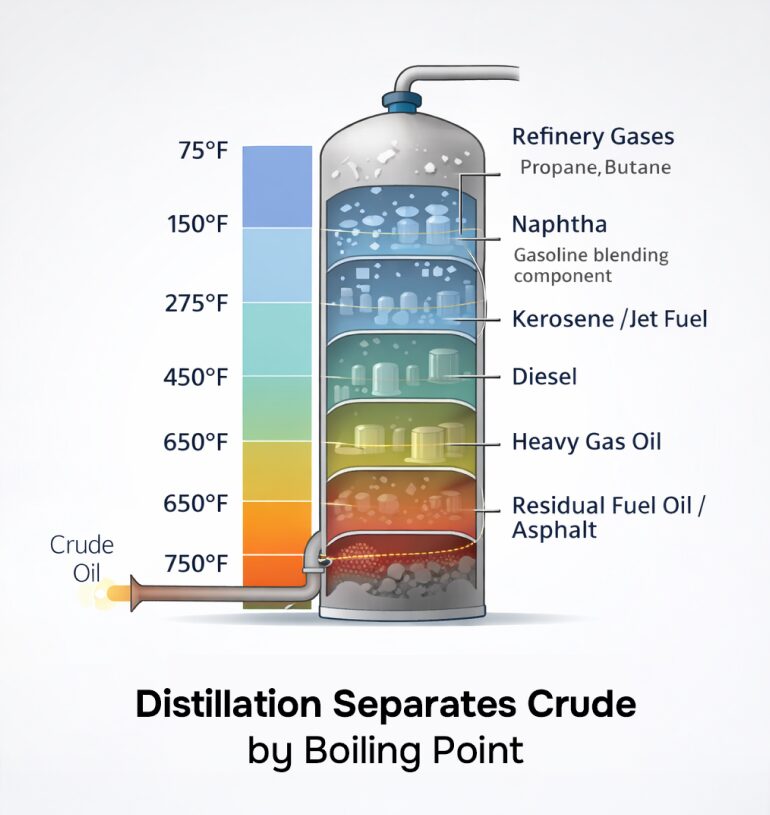
The first step in refining is atmospheric distillation.

Crude oil is heated and fed into a tall distillation column. As vapor rises, different hydrocarbons condense at different temperatures. This separates crude into “fractions” based on boiling point.

Lighter products rise higher in the column:

  • Propane
  • Butane
  • Naphtha (used for gasoline blending)

Heavier products remain lower:

  • Diesel
  • Heating oil
  • Residual fuel oil

This step does not chemically change the oil — it simply separates it based on physical properties.


Conversion: Breaking and Reshaping Molecules

Photograph of a refinery catalytic cracking unit used to convert heavy hydrocarbons into lighter fuels.

After distillation, heavier fractions often need to be converted into lighter, higher-value fuels.

Refineries use processes such as:

  • Fluid catalytic cracking (FCC)
  • Hydrocracking
  • Coking

These processes break large hydrocarbon molecules into smaller ones, increasing gasoline and diesel yields.

The EIA’s discussion of refinery complexity and downstream processing explains how more complex refineries are configured to process heavier crude and maximize transportation fuel output.

Conversion capacity is a major differentiator between simple and complex refineries. More complex facilities can generally process heavier crude slates and, depending on configuration and crude input, extract greater volumes of gasoline, diesel, and jet fuel.


Treatment: Meeting Modern Fuel Standards

Refinery hydrotreating unit used to remove sulfur from fuels to meet environmental standards.

Before fuels reach consumers, they must meet strict environmental and performance standards.

Hydrotreating and desulfurization remove sulfur and other impurities. This step helps ensure:

  • Cleaner combustion
  • Reduced emissions
  • Compliance with domestic and export specifications

The EIA’s fuel sulfur standards and petroleum product FAQs outline how refined fuels must meet specific regulatory thresholds before entering the market.

Treatment is essential for producing ultra-low sulfur diesel and modern gasoline blends that comply with environmental regulations.


What Products Come Out of a Refinery

A single barrel of crude oil yields multiple usable products, including:

  • Gasoline
  • Diesel
  • Jet fuel
  • Liquefied petroleum gases (LPG)
  • Heating oil
  • Asphalt
  • Petrochemical feedstocks

The EIA’s average product yield per barrel of crude oil provides a detailed statistical breakdown of how a standard 42-gallon barrel is typically distributed across product categories.

The exact output mix depends on crude type and refinery configuration.

In the United States, many refineries are configured to maximize gasoline and diesel production, supporting both domestic consumption and export demand.


Why Refinery Capacity Matters

Refinery capacity refers to how much crude oil a refinery can process per day.

Capacity and utilization rates influence, among other factors:

  • Fuel supply availability
  • Regional price spreads
  • Export volumes
  • Seasonal gasoline and diesel inventories

The EIA’s refinery capacity and utilization data tables provide historical and current metrics used by analysts to assess market conditions.

Even when crude production rises, product supply can tighten in certain market conditions if refining capacity is constrained.


How Refining Connects to Energy Exports

Refined products are globally traded commodities.

In recent years, according to the EIA’s petroleum export data series the United States has been one of the world’s largest exporters of refined petroleum products.

Gulf Coast refineries, in particular, process domestic and imported crude and export gasoline, diesel, and jet fuel to Latin America, Europe, and other regions.

Refining capacity is therefore closely linked to domestic fuel supply, export flows, and global petroleum supply chains.


Understanding how refineries operate provides foundational context for analyzing exports, infrastructure investment, and the broader structure of petroleum markets.



About Us

Eagle Natural Resources is a privately held oil and gas operating company based in Texas. We offer accredited investors direct access to U.S. energy projects focused on long-term value, transparency, and responsible development.

Contact

Eagle Natural Resources, LLC
RRC # 253075
5445 Legacy Dr. STE 440 Plano TX 75024
Phone: (833) 553-1534

There are significant risks associated with oil and gas investments. Information found on this site is for general purposes only and is not a solicitation to buy or an offer to sell securities. General information on this site is not intended to be used as individual investment or tax advice. Consult your personal tax advisor concerning the current tax laws and their applicability and effect on your personal tax situation.

Exclusive Opportunities Available Now

We’ve reserved a select number of cash-flowing energy investments for qualified investors. These offerings are available for a limited time and on a first-come basis.

Recipient – Registrant on www.EaglenNaturalResources.com

Disclosing Party – Lexstar Energy, DBA Eagle Natural Resources

Effective Date – Date of Registration

  1. Definitions.

(a) Disclosing Party and Recipient. The party disclosing Confidential Information is referred to as the “Disclosing Party,” and the party receiving Confidential Information is referred to as the “Recipient.”

(b) Confidential Information. “Confidential Information” means all information (whether in oral, written or electronic form) relating to the business, business relationship between disclosing party and recipient, personnel, marketing, customers, finances, products or services of the Disclosing Party, and includes confidential information received by the Disclosing Party from third parties.

  1. Permitted Use of Confidential Information.The Recipient must not use the Disclosing Party’s Confidential Information for any purpose without the explicit written approval of the Disclosing Party.
  2. Protect Confidential Information.The Recipient will keep the Disclosing Party’s Confidential Information confidential, and will also cause its directors, officers, employees and agents to keep the Disclosing Party’s Confidential Information confidential. The Recipient will take all necessary steps (including those steps that the Recipient takes to protect its own information that it regards as confidential) to maintain the confidentiality of the Disclosing Party’s Confidential Information.
  3. No Disclosure.The Recipient will not disclose the Confidential Information to any third party, nor the fact that it has obtained the Confidential Information, without the explicit written approval of the Disclosing Party.
  4. Legal Compulsion to Disclose Confidential Information.If the Recipient receives notice indicating that it may or will be legally required to disclose any of the Disclosing Party’s Confidential Information, it will notify the Disclosing Party promptly in writing so that the Disclosing Party may seek a protective order or other appropriate remedy, or waive compliance with this Agreement. If a protective order or other remedy is not obtained for whatever reason, or if the Disclosing Party waives compliance with this Agreement, the Recipient will disclose no more than that portion of the Confidential Information required to be disclosed.
  5. No Transfer.The Disclosing Party retains exclusive rights to its Confidential Information, and does not grant or transfer any right or license to the Recipient, except as set out in this Agreement.
  6. Return or Destruction.Within five business days of a request by the Disclosing Party:

(a) the Recipient will return to the Disclosing Party all materials in physical form (including any notes, summaries or memoranda relating to or derived from those materials by the Recipient) that contain the Disclosing Party’s Confidential Information or, at the Disclosing Party’s option, the Recipient may certify in writing that it has destroyed all such materials permanently and confidentially; and

(b) the Recipient will certify in writing that it has destroyed permanently all materials in electronic form (including emails and including any notes, summaries or memoranda relating to or derived from those materials by the Recipient) that contain the Disclosing Party’s Confidential Information.

  1. Disclosing Party Not Liable.The Recipient acknowledges that the Disclosing Party, its directors and its officers will have no liability to the Recipient resulting from the use of the Confidential Information by the Recipient.
  2. Non‑money Remedies.The Recipient acknowledges that money damages would not be a sufficient remedy for a breach of this Agreement, and that any court having jurisdiction may grant injunctive relief for an actual or threatened breach of any of the provisions of this Agreement, in addition to any other remedy available to the Disclosing Party.
  3. Integration.This Agreement constitutes the entire agreement between the parties relating to its subject matter. No amendment or waiver of this Agreement is binding unless agreed to in writing by the parties.
  4. Governing Law.This Agreement is governed by the laws in effect in the State of Texas.