
Share on:

Why Risk Matters in Energy Investing

Oil and gas investing is often discussed in terms of returns, production growth, or market demand. Less often emphasized—but equally important—is risk. Every energy investment carries uncertainty, and understanding where that uncertainty comes from is a foundational step for long-term investors.

Risk does not automatically imply poor outcomes. In energy markets, risk and return are closely linked. The key is knowing which risks exist, how they behave, and why they matter.
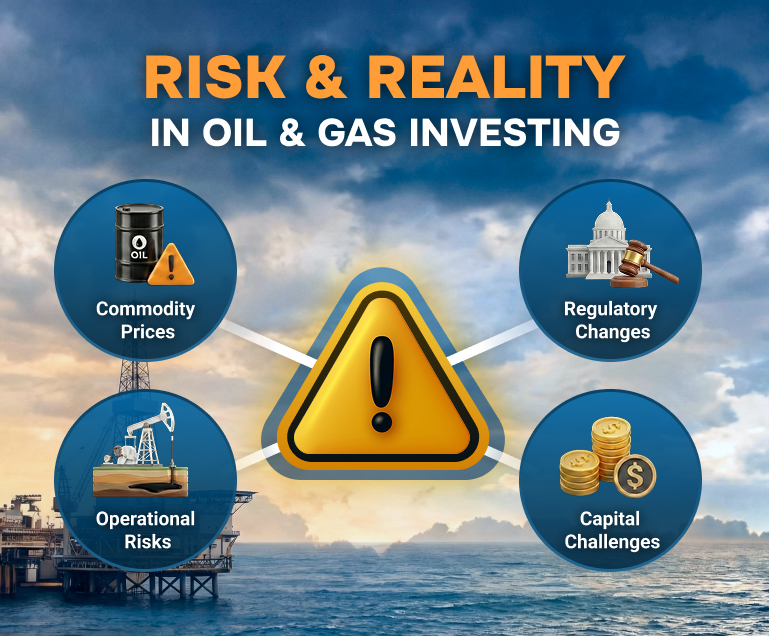
Overview graphic showing multiple categories of oil and gas investment risk

Commodity Price Volatility

Oil and natural gas prices are influenced by global supply and demand, geopolitics, weather, and economic conditions. These forces can change quickly, creating price volatility that affects revenues, cash flow, and project economics.

For investors, this means performance can fluctuate even when production remains steady. Price risk is inherent to commodities and cannot be eliminated—only understood and managed.
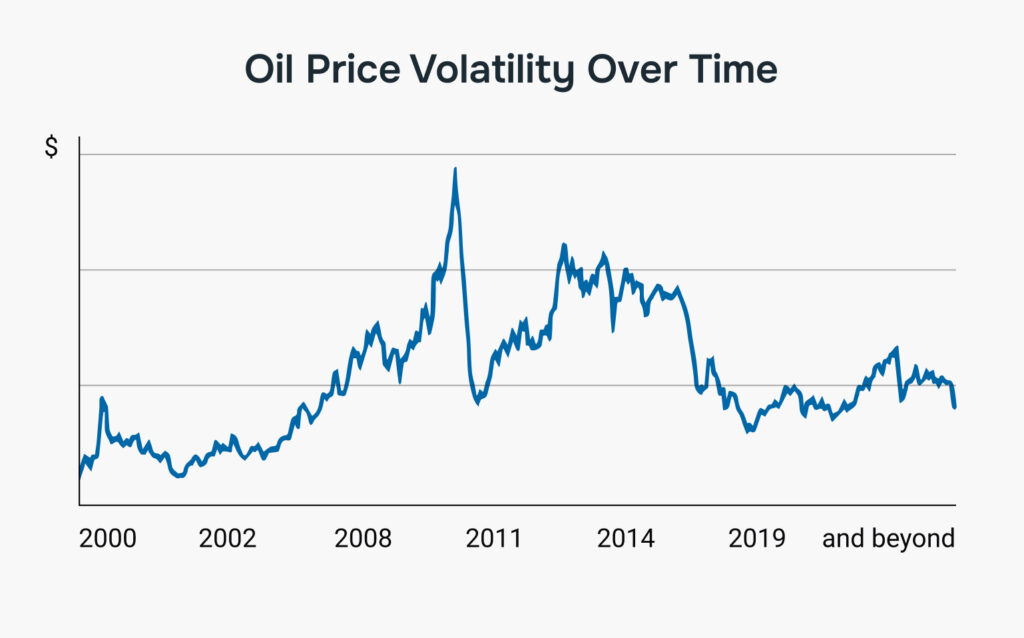
Line chart showing historical oil price volatility over time

Regulatory and Policy Risk

Energy development operates within a regulatory framework that can evolve over time. Changes in permitting rules, environmental standards, taxation, or land access can impact project timelines and costs.

Policy risk varies by region and asset type, making geographic diversification and regulatory awareness important considerations for investors evaluating long-lived energy assets.
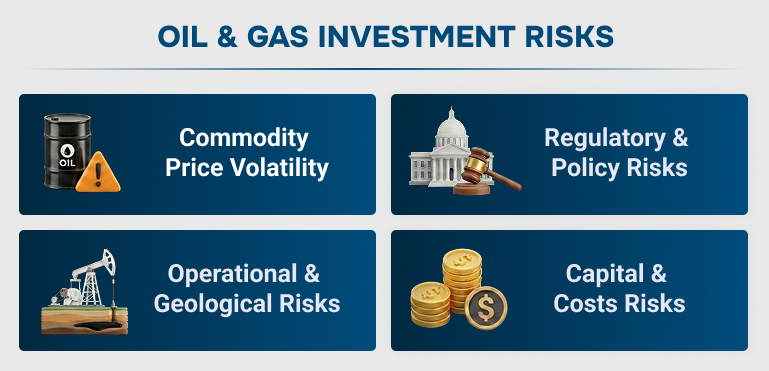
Map or icons representing regulatory and policy influences on energy projects

Operational and Geological Risk

Oil and gas projects depend on complex operations and subsurface geology. Drilling results, reservoir performance, equipment reliability, and infrastructure access all affect outcomes.

Even with advanced technology and data, uncertainty remains. This is why operational expertise and conservative assumptions play a critical role in responsible energy investing.


Capital Intensity and Cost Overruns

Energy projects often require significant upfront capital before generating returns. Unexpected delays, inflation in service costs, or supply chain constraints can increase project expenses.

Capital discipline—how projects are planned, funded, and managed—can meaningfully influence long-term performance, especially during periods of market stress.
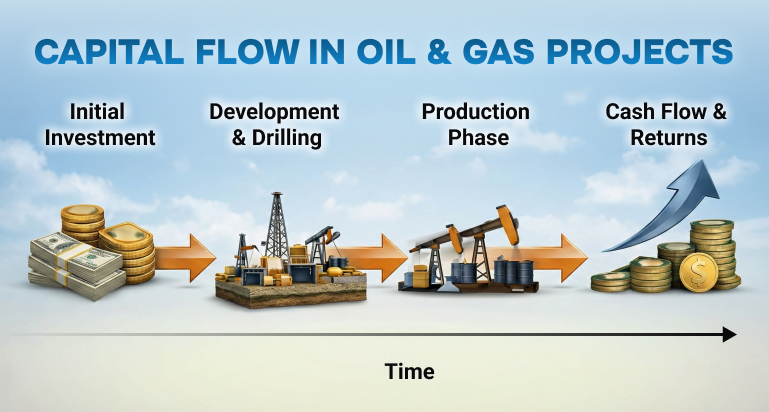
Illustration showing capital flow from investment to production over time

Market Cycles and Timing Risk

Energy markets are cyclical. Periods of high prices often lead to increased investment, which can eventually result in oversupply and price declines. Conversely, underinvestment can tighten supply over time.

Understanding these cycles helps investors set expectations and avoid evaluating long-term assets based solely on short-term conditions.


Understanding Risk vs. Avoiding It

Risk is not something energy investors can avoid entirely. Instead, it is something to evaluate, price, and manage. A clear understanding of risk supports better decision-making, more realistic expectations, and stronger alignment with long-term investment goals.

For many investors, education is the first step toward confidence.


Resources

U.S. Energy Information Administration (EIA)
Authoritative data and analysis on U.S. oil, gas, and energy markets.
https://www.eia.gov

These resources are provided for general education and independent research. They are not intended as market forecasts or investment guidance.


About Us

Eagle Natural Resources is a privately held oil and gas operating company based in Texas. We offer accredited investors direct access to U.S. energy projects focused on long-term value, transparency, and responsible development.

Contact

Eagle Natural Resources, LLC
RRC # 253075
5445 Legacy Dr. STE 440 Plano TX 75024
Phone: (833) 553-1534

There are significant risks associated with oil and gas investments. Information found on this site is for general purposes only and is not a solicitation to buy or an offer to sell securities. General information on this site is not intended to be used as individual investment or tax advice. Consult your personal tax advisor concerning the current tax laws and their applicability and effect on your personal tax situation.

Exclusive Opportunities Available Now

We’ve reserved a select number of cash-flowing energy investments for qualified investors. These offerings are available for a limited time and on a first-come basis.

Recipient – Registrant on www.EaglenNaturalResources.com

Disclosing Party – Lexstar Energy, DBA Eagle Natural Resources

Effective Date – Date of Registration

  1. Definitions.

(a) Disclosing Party and Recipient. The party disclosing Confidential Information is referred to as the “Disclosing Party,” and the party receiving Confidential Information is referred to as the “Recipient.”

(b) Confidential Information. “Confidential Information” means all information (whether in oral, written or electronic form) relating to the business, business relationship between disclosing party and recipient, personnel, marketing, customers, finances, products or services of the Disclosing Party, and includes confidential information received by the Disclosing Party from third parties.

  1. Permitted Use of Confidential Information.The Recipient must not use the Disclosing Party’s Confidential Information for any purpose without the explicit written approval of the Disclosing Party.
  2. Protect Confidential Information.The Recipient will keep the Disclosing Party’s Confidential Information confidential, and will also cause its directors, officers, employees and agents to keep the Disclosing Party’s Confidential Information confidential. The Recipient will take all necessary steps (including those steps that the Recipient takes to protect its own information that it regards as confidential) to maintain the confidentiality of the Disclosing Party’s Confidential Information.
  3. No Disclosure.The Recipient will not disclose the Confidential Information to any third party, nor the fact that it has obtained the Confidential Information, without the explicit written approval of the Disclosing Party.
  4. Legal Compulsion to Disclose Confidential Information.If the Recipient receives notice indicating that it may or will be legally required to disclose any of the Disclosing Party’s Confidential Information, it will notify the Disclosing Party promptly in writing so that the Disclosing Party may seek a protective order or other appropriate remedy, or waive compliance with this Agreement. If a protective order or other remedy is not obtained for whatever reason, or if the Disclosing Party waives compliance with this Agreement, the Recipient will disclose no more than that portion of the Confidential Information required to be disclosed.
  5. No Transfer.The Disclosing Party retains exclusive rights to its Confidential Information, and does not grant or transfer any right or license to the Recipient, except as set out in this Agreement.
  6. Return or Destruction.Within five business days of a request by the Disclosing Party:

(a) the Recipient will return to the Disclosing Party all materials in physical form (including any notes, summaries or memoranda relating to or derived from those materials by the Recipient) that contain the Disclosing Party’s Confidential Information or, at the Disclosing Party’s option, the Recipient may certify in writing that it has destroyed all such materials permanently and confidentially; and

(b) the Recipient will certify in writing that it has destroyed permanently all materials in electronic form (including emails and including any notes, summaries or memoranda relating to or derived from those materials by the Recipient) that contain the Disclosing Party’s Confidential Information.

  1. Disclosing Party Not Liable.The Recipient acknowledges that the Disclosing Party, its directors and its officers will have no liability to the Recipient resulting from the use of the Confidential Information by the Recipient.
  2. Non‑money Remedies.The Recipient acknowledges that money damages would not be a sufficient remedy for a breach of this Agreement, and that any court having jurisdiction may grant injunctive relief for an actual or threatened breach of any of the provisions of this Agreement, in addition to any other remedy available to the Disclosing Party.
  3. Integration.This Agreement constitutes the entire agreement between the parties relating to its subject matter. No amendment or waiver of this Agreement is binding unless agreed to in writing by the parties.
  4. Governing Law.This Agreement is governed by the laws in effect in the State of Texas.