
Most high earners have a number they don’t talk about much.
Not their income, not their net worth – their effective tax rate after everything their CPA could legally do has already been done.
For a lot of people clearing $500,000-plus a year, that number still starts with a three. Sometimes a four. And it tends to stay there even after the 401(k) is maxed, the entity is structured properly, and the depreciation schedules have been run.
So when someone mentions an effective rate in the high teens, it gets attention.
The explanation is usually vague – “a structure,” “something in energy,” “my guy handles it” – but the underlying mechanism isn’t a secret. It’s written into the tax code, and it’s been there since the 1950s.
Where the conventional playbook stops working
To be clear, the standard tools aren’t bad. They’re just limited.
A 401(k) shelters $24,500 a year. A defined benefit plan tops out somewhere between $200,000 and $265,000 depending on age and structure. For someone with a $350,000 federal liability, that helps – but it doesn’t change the shape of the problem.
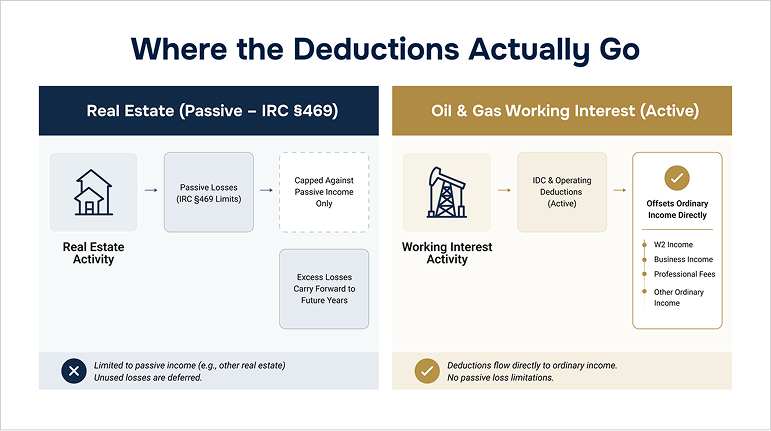
Real estate is the other go-to, and the deductions are real. But under IRC §469, passive losses can generally only offset passive income. That’s why cost segregation, however large the paper deduction, often doesn’t touch W-2 income, business revenue, or professional fees. The losses sit suspended until matching passive income shows up, or until the property sells.
Run every conventional lever at once – retirement accounts, entity structuring, real estate depreciation, charitable giving – and at high income levels it typically moves the bill by something like 10 to 20%. The rest tends to remain.
The category that works differently: direct working interests in oil and gas
This is the part that usually gets misunderstood, so it’s worth being precise.
Buying an energy stock isn’t this. An oil and gas ETF isn’t this. Units in a publicly traded MLP aren’t this either – those are securities, taxed as securities.
A direct working interest is something else: an actual ownership position in the drilling and production of a specific well. Because the investor is participating directly in the activity rather than holding a security, the tax code treats them as a working interest holder rather than a passive investor – and that distinction is what unlocks three specific provisions.
1. Intangible Drilling Costs (IRC §263(c))
Drilling a well involves a lot of cost with no salvage value – labor, fuel, hauling, site prep. The IRS classifies these as intangible drilling costs (IDCs), and operators can elect to deduct them in the year incurred rather than capitalizing them over time.
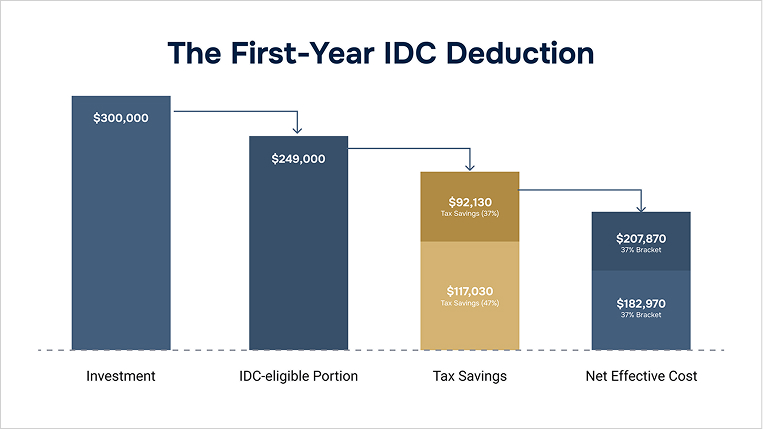
For independent producers, IDCs typically run 70–85% of total drilling cost. On a $300,000 investment where IDCs make up 83%, that’s $249,000 eligible for a same-year deduction. At a 37% federal bracket, that’s roughly $92,000 in tax savings; at a combined 47% rate, more than $117,000. The effective net cost of the position, before a single barrel is produced, can land somewhere in the $183,000–$208,000 range.
2. The working interest exemption from passive activity rules (IRC §469)
This is the provision that separates oil and gas working interests from almost every other tax-advantaged structure on offer to high earners.
Passive activity rules are exactly what limits the usefulness of real estate losses for most investors – the deductions can only offset passive income. A working interest in an oil or gas well is explicitly carved out of that treatment. Per the IRS’s own Schedule E instructions, a working interest isn’t treated as a passive activity even without material participation. That makes it active income by classification – which means the deductions it generates can offset ordinary income directly: W-2 wages, business income, professional fees.
3. The depletion allowance (IRC §613A)
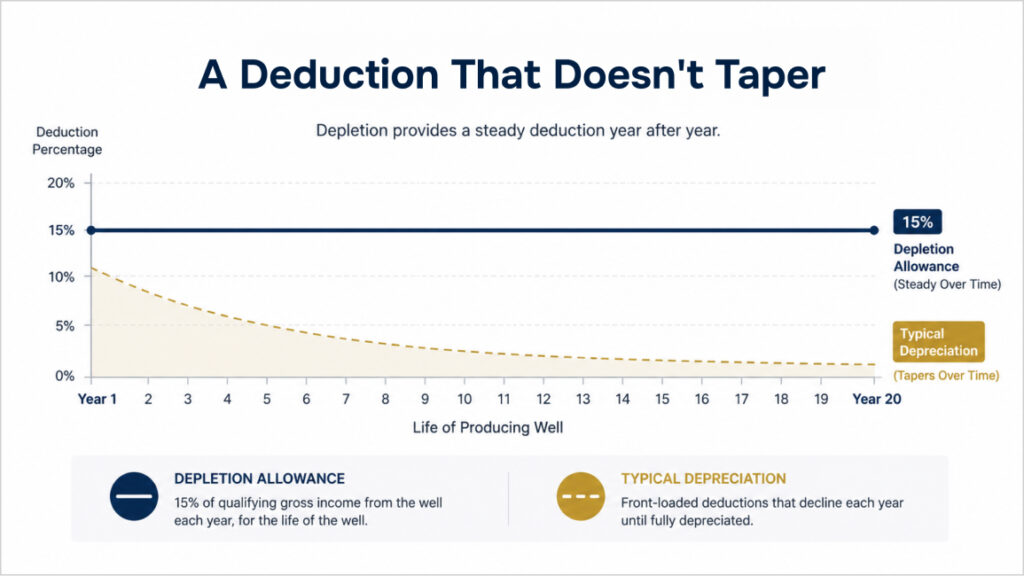
IDCs are a front-loaded benefit. Depletion is the provision that keeps giving. Working interest holders can deduct 15% of gross income from the well each year, calculated on income produced rather than remaining basis – so it doesn’t taper off as the original investment is recovered. A well producing steadily for 15–20 years carries that 15% deduction on every year of income, year one and year fifteen alike.
Where this fits
This isn’t a loophole or an aggressive position – IRC §263(c), §469, and §613A have sat largely unchanged in the tax code for around seventy years, written specifically to incentivize private capital into domestic drilling. Any CPA can pull them up and walk through the math.
It’s also not a fit for everyone, by design. The investors for whom this changes the equation are generally earning $500,000+ annually with a net worth above $3 million outside the primary residence – people who’ve already exhausted the conventional toolkit and are still writing a check that reflects the gap between it and what’s actually available in the code.
Firms like Eagle Natural Resources structure these as project-specific joint ventures in domestic working interests – in Eagle’s case, across more than 500 producing wells in the Permian Basin – giving accredited investors direct exposure to both the production economics and the tax treatment described above.
If the mechanics here are new, it’s worth a conversation with your tax advisor before anything else — the provisions are specific enough that eligibility depends on individual circumstances, and this isn’t a decision to make from a blog post alone.
This article is for informational and educational purposes only and doesn’t constitute tax, legal, or investment advice. Consult a qualified tax advisor before making investment decisions. Eligibility for the deductions discussed depends on individual circumstances, and past well performance doesn’t guarantee future results.