Share on:

When crude prices move – and they always move – the instinct is to treat it as a signal. Something must be happening. Something must be wrong.

Usually, it’s just the market doing what the market does. And if you react to every move, you risk making decisions based on noise rather than the fundamentals that actually determine whether an investment performs.


Why Prices Are Always Moving
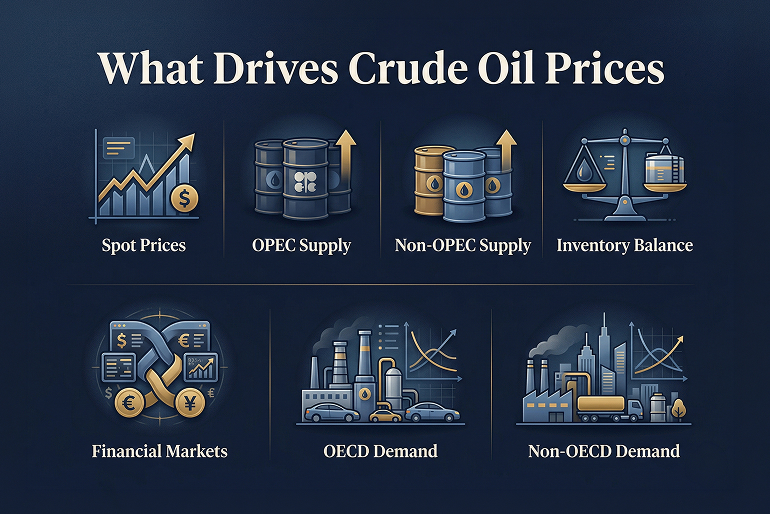
Grid showing the seven factors that influence crude oil prices according to the U.S. Energy Information Administration

Both crude oil and petroleum product prices can be affected by events that have the potential to disrupt the flow of oil and products to market, including geopolitical and weather-related developments. That’s a broad category. It includes hurricanes, elections, pipeline outages, sanctions, and conflicts – many of which resolve without ever affecting a single barrel of actual production.

The deeper reason prices move so readily comes down to structure. The volatility of oil prices is inherently tied to the low responsiveness – or “inelasticity” – of both supply and demand to price changes in the short run. It takes years to develop new supply sources or vary production, and it is very hard for consumers to switch to other fuels or increase fuel efficiency in the near term when prices rise. In a market that can’t quickly adjust in either direction, prices have to do a lot of the heavy lifting.

For investors, this is a critical distinction. Price movement and investment risk are not the same thing. A market that moves frequently isn’t necessarily a market that’s deteriorating.


The Risk Premium Problem
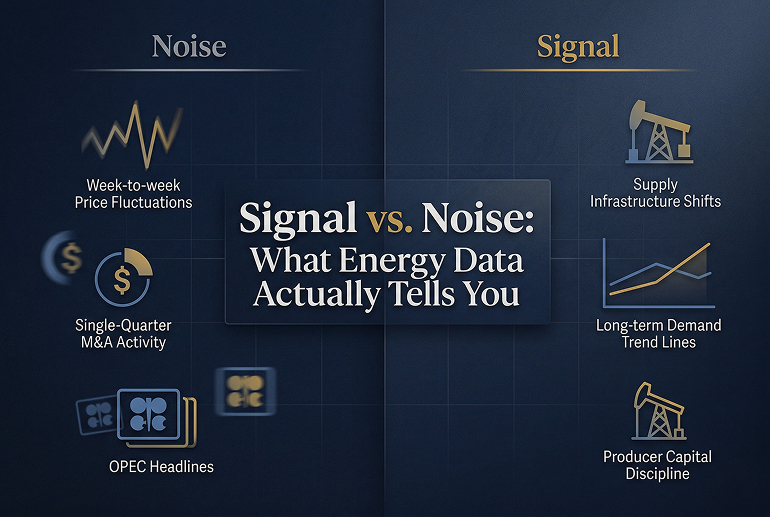
Visually reinforce the article's core distinction between short-term noise and long-term signal

Here’s where most investors misread the data. Market participants are always assessing the possibility of future disruptions and their potential impacts – not just current ones. When spare capacity is low and inventories are thin, even a possible disruption can move prices above what current supply and demand would justify, as forward-looking behaviour adds a risk premium.

That means a price spike doesn’t necessarily mean anything has happened. It may mean traders are pricing in something that might happen. Those are very different situations – and they warrant very different responses from a long-term investor.

Reacting to a risk premium as though it were a confirmed supply crisis is one of the most common – and costly – mistakes an energy investor can make.


What Actually Matters

The influence of these types of factors on oil prices tends to be relatively short lived. Once the problem subsides and oil and product flows return to normal, prices usually return to previous levels.

The U.S. Energy Information Administration tracks seven factors that drive crude oil prices over time: spot prices, OPEC supply, non-OPEC supply, global inventory balance, financial market activity, and demand from both developed and emerging economies. Any one of them, in isolation, can cause a short-term move. But it’s the interplay of all seven – the actual supply-demand balance – that determines where prices settle.

Reading a single data point without that context is like reading one word of a sentence and guessing the paragraph. And basing an investment decision on that single data point is how long-term returns get sacrificed to short-term anxiety.


The Investor’s Posture

The price of oil on any given Tuesday is not the investment thesis. The structural demand for energy, the quality of the underlying asset, and the discipline of the operator – those are the investment thesis.

Investors who keep that distinction clear tend to make better decisions – not because they have better data, but because they’re asking better questions.

At Eagle Natural Resources, we work with accredited investors who want direct participation in U.S. oil and gas – not exposure to the headline, but access to the underlying opportunity. If you’d like to understand how we evaluate projects through price cycles, we’re happy to walk you through our approach.


For educational purposes only. Direct investments in oil and gas carry risk, including potential loss of principal.



About Us

Eagle Natural Resources is a privately held oil and gas operating company based in Texas. We offer accredited investors direct access to U.S. energy projects focused on long-term value, transparency, and responsible development.

Contact

Eagle Natural Resources, LLC
RRC # 253075
5445 Legacy Dr. STE 440 Plano TX 75024
Phone: (833) 553-1534

There are significant risks associated with oil and gas investments. Information found on this site is for general purposes only and is not a solicitation to buy or an offer to sell securities. General information on this site is not intended to be used as individual investment or tax advice. Consult your personal tax advisor concerning the current tax laws and their applicability and effect on your personal tax situation.

Exclusive Opportunities Available Now

We’ve reserved a select number of cash-flowing energy investments for qualified investors. These offerings are available for a limited time and on a first-come basis.

Recipient – Registrant on www.EaglenNaturalResources.com

Disclosing Party – Lexstar Energy, DBA Eagle Natural Resources

Effective Date – Date of Registration

  1. Definitions.

(a) Disclosing Party and Recipient. The party disclosing Confidential Information is referred to as the “Disclosing Party,” and the party receiving Confidential Information is referred to as the “Recipient.”

(b) Confidential Information. “Confidential Information” means all information (whether in oral, written or electronic form) relating to the business, business relationship between disclosing party and recipient, personnel, marketing, customers, finances, products or services of the Disclosing Party, and includes confidential information received by the Disclosing Party from third parties.

  1. Permitted Use of Confidential Information.The Recipient must not use the Disclosing Party’s Confidential Information for any purpose without the explicit written approval of the Disclosing Party.
  2. Protect Confidential Information.The Recipient will keep the Disclosing Party’s Confidential Information confidential, and will also cause its directors, officers, employees and agents to keep the Disclosing Party’s Confidential Information confidential. The Recipient will take all necessary steps (including those steps that the Recipient takes to protect its own information that it regards as confidential) to maintain the confidentiality of the Disclosing Party’s Confidential Information.
  3. No Disclosure.The Recipient will not disclose the Confidential Information to any third party, nor the fact that it has obtained the Confidential Information, without the explicit written approval of the Disclosing Party.
  4. Legal Compulsion to Disclose Confidential Information.If the Recipient receives notice indicating that it may or will be legally required to disclose any of the Disclosing Party’s Confidential Information, it will notify the Disclosing Party promptly in writing so that the Disclosing Party may seek a protective order or other appropriate remedy, or waive compliance with this Agreement. If a protective order or other remedy is not obtained for whatever reason, or if the Disclosing Party waives compliance with this Agreement, the Recipient will disclose no more than that portion of the Confidential Information required to be disclosed.
  5. No Transfer.The Disclosing Party retains exclusive rights to its Confidential Information, and does not grant or transfer any right or license to the Recipient, except as set out in this Agreement.
  6. Return or Destruction.Within five business days of a request by the Disclosing Party:

(a) the Recipient will return to the Disclosing Party all materials in physical form (including any notes, summaries or memoranda relating to or derived from those materials by the Recipient) that contain the Disclosing Party’s Confidential Information or, at the Disclosing Party’s option, the Recipient may certify in writing that it has destroyed all such materials permanently and confidentially; and

(b) the Recipient will certify in writing that it has destroyed permanently all materials in electronic form (including emails and including any notes, summaries or memoranda relating to or derived from those materials by the Recipient) that contain the Disclosing Party’s Confidential Information.

  1. Disclosing Party Not Liable.The Recipient acknowledges that the Disclosing Party, its directors and its officers will have no liability to the Recipient resulting from the use of the Confidential Information by the Recipient.
  2. Non‑money Remedies.The Recipient acknowledges that money damages would not be a sufficient remedy for a breach of this Agreement, and that any court having jurisdiction may grant injunctive relief for an actual or threatened breach of any of the provisions of this Agreement, in addition to any other remedy available to the Disclosing Party.
  3. Integration.This Agreement constitutes the entire agreement between the parties relating to its subject matter. No amendment or waiver of this Agreement is binding unless agreed to in writing by the parties.
  4. Governing Law.This Agreement is governed by the laws in effect in the State of Texas.