
Oil demand forecasts often make headlines. But small changes in these forecasts don’t usually signal a major shift—they help frame how the market may evolve over time.
Recent updates suggest a simple takeaway: demand is still expected to grow, just a bit more slowly than previously thought.
What’s actually changed
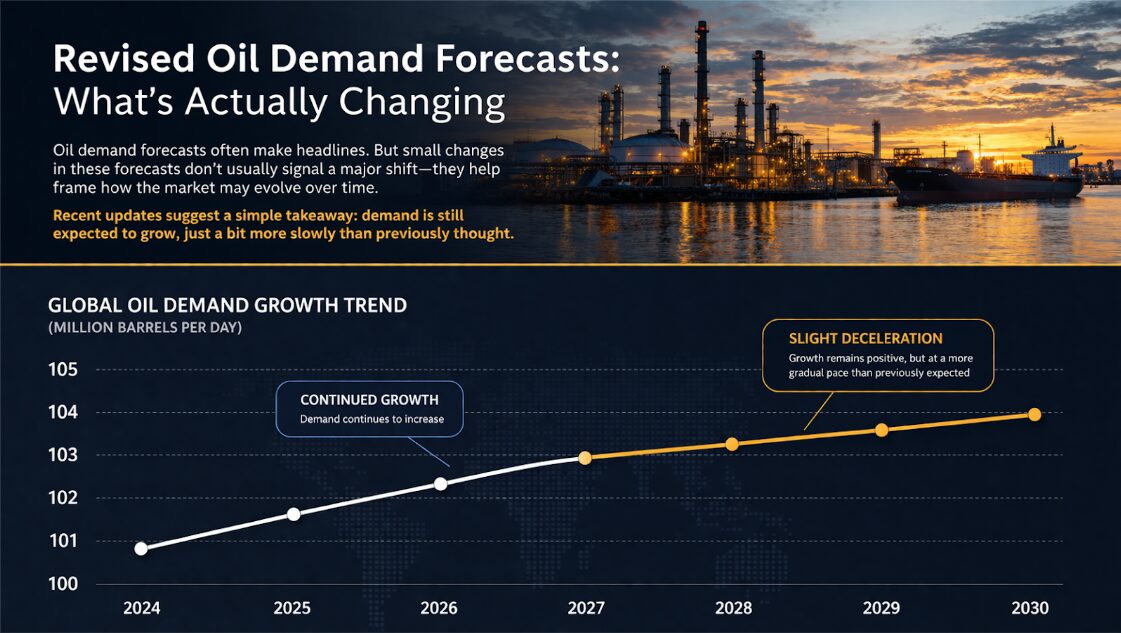
Recent forecasts from major institutions are still pointing in the same general direction, but with slightly different pacing.
The International Energy Agency (IEA) has lowered its near-term growth expectations. Demand is still rising, but not as quickly, and its outlook allows for a potential surplus under certain assumptions.
OPEC continues to project steady growth over the next few years, with ongoing demand for its supply.
Investment banks, such as J.P. Morgan, typically fall somewhere in between—adjusting expectations without shifting to extreme outcomes.
The key point: the story hasn’t reversed. Expectations have simply become more moderate.
Why this matters (in simple terms)
1. Growth is slowing — but not stopping
Oil demand is still expected to increase. The difference is that it may grow more gradually.
2. Discipline remains important
With steady (but not accelerating) demand, companies may stay focused on efficiency and returns rather than aggressive growth.
That means:
- Prioritizing existing assets
- Managing costs
- Returning capital where possible
Instead of chasing volume, the focus often shifts to consistency.
3. Where demand grows matters more
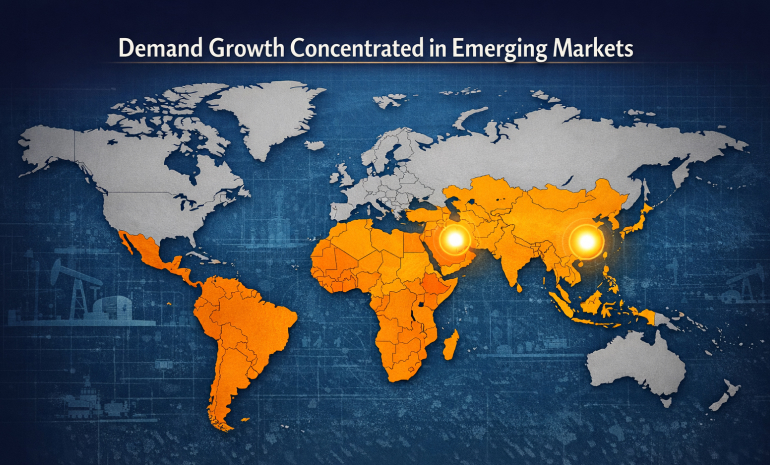
Most demand growth is expected to come from emerging markets, particularly in Asia.
This means:
- Location and logistics matter
- Infrastructure and access to these markets matter
- Not all barrels are equally valuable
In simple terms, where oil goes can matter as much as how much is used globally.
4. “Peak demand” is a gradual idea
Recent updates still support a slow transition rather than a sudden drop.
Oil demand may level off over time—but current forecasts don’t point to an abrupt decline.
What these forecasts don’t tell us
They don’t predict short-term prices
Oil prices can move quickly due to geopolitics, supply disruptions, or policy decisions.
Long-term demand forecasts don’t change that.
They aren’t exact predictions
Each forecast is based on assumptions about:
- Economic growth
- Technology adoption
- Policy decisions
These factors can change, and forecasts adjust with them.
They don’t remove supply uncertainty
Even with slower demand growth, supply can still be tight due to:
- Limited long-term investment
- Natural decline in existing production
- Regulatory constraints
This means markets can still react strongly to disruptions.
A simple way to think about it
Demand revisions are most useful as a framework, not a signal.
Instead of treating forecasts as precise signals, it can be more useful to view them as a general guide.
At a high level, they help answer questions like:
- Is demand growing, shrinking, or stabilizing?
- How fast is that change happening?
- Where is that demand coming from?
Right now, the answer is relatively clear:
growth continues, but at a slower and more measured pace.